Nicotine is one of the more addictive stimulants/anxiolytics. It is a natural alkaloid present in tobacco. It acts as both an agonist of nAChRs (nicotinic acetylcholine receptors) and an antagonist in at least two identified subunits. It has wide pharmaceutical interest and recreational usage over the counter in products such as medicine, cigarettes, tobacco products, and more.
There are many identified pathways towards the chemical synthesis of nicotine and its analogues with varying yields. I will first describe it’s total synthesis.
Total synthesis of Nicotine:
One synthetic method (known as the Hoffman-Loffler reaction) of obtaining nicotine comprises starting with pyridine 3-carboxaldehyde and alkylating it’s ketone at the 1,2 position with methylmagnesium bromide in Tetrahydrofuran. The amide that results undergoes C-H amination at the methylene position using an electrophillic Iodine reagent [I-O2CAr]. This reaction forms a hemiaminal derivative which is then changed under an acidic detosylation with subsequent imine reduction to provide a pyrrolidine intermediate. Further N-methylation yields nicotine.

Enzymatic synthesis of nicotine:
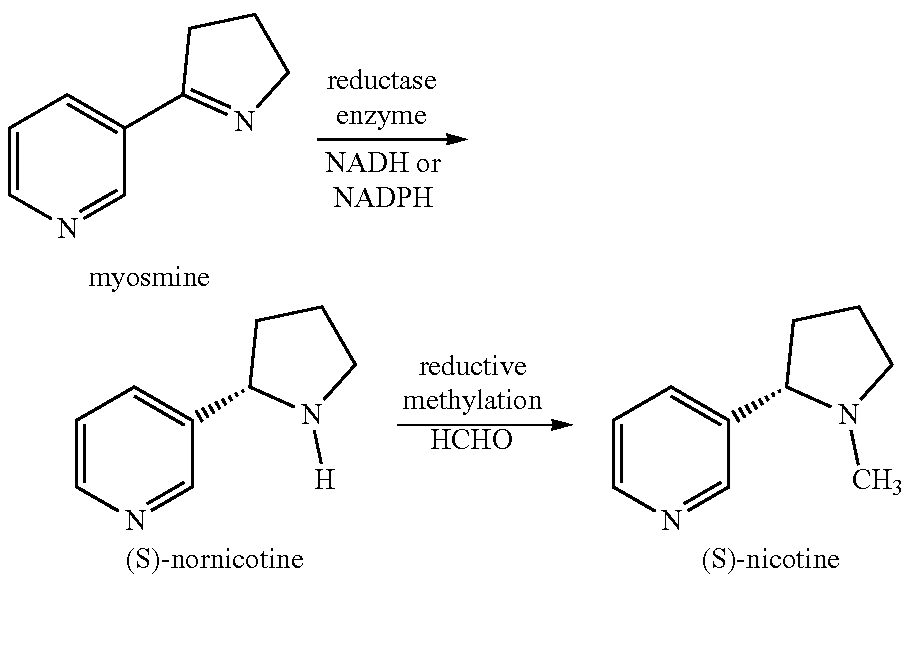
This efficient synthesis proceeds through the double bond reduction of myosmine using an NADH/NAPDH dependent enzyme with imine reductase activity to form enantioselective (S)-nornicotine. Nornicotine is then further methylated utilizing formaldehyde in the presence of a reductant such as formic acid.
Structural analogs of nicotine:

References:
Enantioselective Synthesis of Nicotine via an Iodine-Mediated Hoffman-Loffler reaction. Estefania Del Castillo and Kilian Muniz. Organic Letters. 2019. 21 (3), 705-708.
A New Synthesis of Nornicotine and Nicotine. Lyman C. Craig. J. Am. Chem. Soc. 1933. 55(7), 2854-2857.
US Patent 10,913,962 B2
Pharmacology of Nicotine. Johan Grenhoff and Torgny H. Svensson. British Journal of Addiction. 1989. 84(5), 477-492.
Leave a Reply