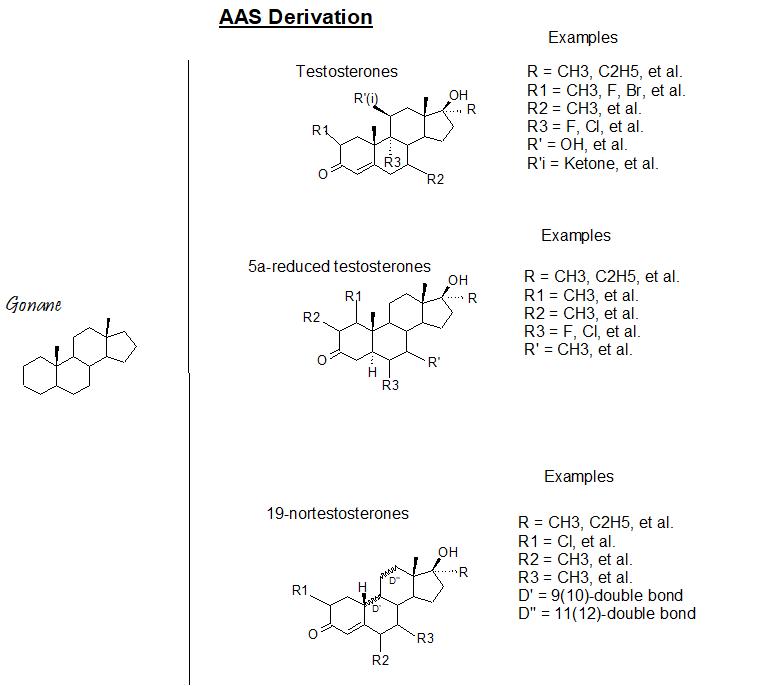
Androgens can be grouped into three core categories (4,5 testosterones, 5a-reduced testosterones, 19-nortestosterones) while also having other modifitory changes such as retro or iso streroids, carbon nor or carbon homo steroids, and other novelties with anabolic/androgenic activity. Most preferred activity of androgens in most instances medicinally would be anabolic with a strong separation of androgenic activity targeting muscle-wasting prevention or decreasement. In other cases androgenic activity is preferred in a particular chosen steroid to induce the on-set of puberty in males.
When the steroid is administered whether orally or by injection it reaches either the liver via the former or a systemic release into the bloodstream via the latter mentioned method. It should be noted that topical administration of androgens is a well known and well used application of a steroid. I will subcategorize only two of these three types of common Moa (Method of administration) disregarding other applicable routes (intranasal, suppository).
Methods of administration:
Oral administration:
Most common among this type are a specific class of structurally modified steroids known to be identified as 17a-alkyls. Alkylation of Carbon-17 includes methyl, ethyl, vinyl, and several other functional groups introduced into the ‘carbonyl attacked’ position synthetically. First discovered by a group of scientists in 1935 it is highly regarded as being the core component of the most effective, but also the most toxic substituted steroidals ever chemically produced. Other forms of the oral method with which seem to be also quite effective are those lesser confined as etherified steroids, chemically complexed solutions, and novel steroids with already high biological effectiveness in unchanged form.
Injection Moa:
Most used among this type, whether medicinally or recreationally, are subcutaneous (abbr. Subq) and intramuscular (abbr. IM) although other areas of intrainjection such as near the brain can also be utilized. Subcutaneous was most used for research purposes in this class of compounds, while intramuscular was used often for patient treatment. The two are near equally as bioeffective with advantages depending on the ester in some cases and other cases site specific induction of the compound itself. 17b-esterification is the most common modification permitting sustained release of the molecule into the bloodstream when the ester is hydrolyzed in the body individually or near simultaneously. Carbon-17 beta oriented Acetates, benzoates, propanoates, enanthates, undecanoates, etc. are most typical.
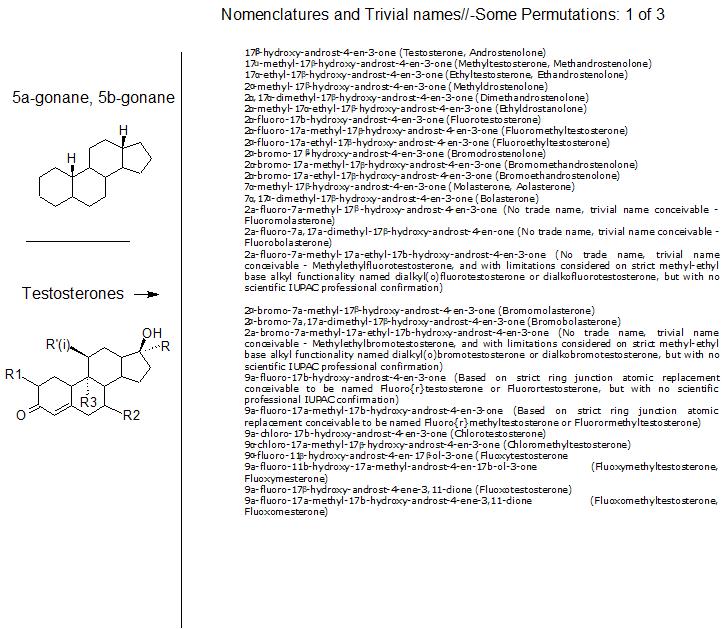
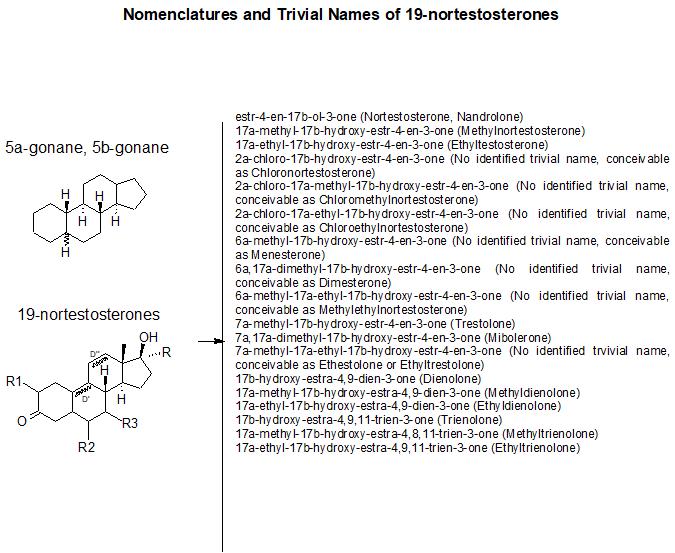
I have displayed three graphics for informational purposes describing some (or many) possible permutations of molecules both synthesized and potentially unmade in pharmaceutical corporate environments. Their nomenclatures and trivial names are included with the attached reference of basis that I also prepared:


Leave a Reply