Epinephrine:
Beyond the most simple of stimulants such as caffeine, there exist natural and bioorganic species of compounds known as epinephrines, or the adrenal hormones. They regulate adrenaline among many other things characteristic of bodily stimulation. Epinephrine, or adrenaline, is produced at a normal or alarming rate dependent on the species in consideration. It resembles an amphetamine in some instincts having a simple base hydrocarbon benzoic backbone and multiple natural indicators of suppressive pharmacology such as strong presence of hydroxylation in its natural structure.

- One aromatic cyclohexane ring
- One chain-extension ethylamine coming off the ring
- Three hydroxyl groups positioned on the molecule, two on the cyclic ring
- C9H13NO3
Binding to adrenergic receptors, epinephrines exude strong capabilities to maintain the sympathetic nervous system (SNS) which is responsible for f-o-f (fight-or-flight) responsiveness in basic or complex organisms. Expected natural effects are often observed in congruence with symptomatic biology.
ARα and ARβ are the two identified receptors responsible for adrenergic receptor affinity and pharmacological activity of epinephrines. Norepinephrine and several designer epinephrine analogs will be characterized and described by me as well as their agonistic association with adrenergic receptors.
Norepinephrine:
Standard epinephrine set aside, there is a somewhat more pharmaceutically efficacious adrenergic produced biosynthetically with very specific differentiation in structure and it is trivialized as nor-epinephrine.

- One aromatic cyclohexane ring
- One chain extended amination coming off of the ring
- Three hydroxyl groups positioned on the molecule, two planar on the cyclic aromatic ring
- C8H11NO3
As this compound is a well-known phenethylamine, it is important to understand it is very much like its methylated counterpart epinephrine, binding to the same type of adrenergic receptors alpha and beta, it exerts its activity as a psychostimulant and condition intensifier in places where CNS localization is often characterized. With a somewhat cleaner structure it is very possible and understandable that it may have a better overall net binding stability to the ligand-binding domain (LBD) of adrenergic receptors. Well-used in medicine and medicinal production it maintains a highly respectable status on the re-search, development, and production of natural and synthetic adrenal hormones acting quite similar to other bio- epinephric drugs with regard to stimulation.
Chemical synthesis of epinephrine:
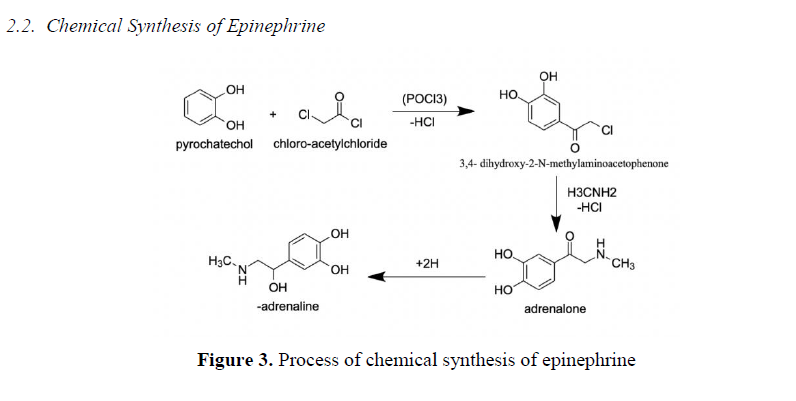
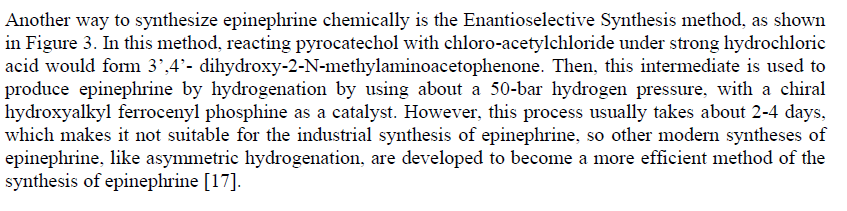
While this process is well described in the literature, further description is of interest. The starting material pyrochatechol is reacted with chloro-acetylchloride and phosphorus oxychloride under HCl. The presence of this reagent (POCl3) under HCl bonds the two molecules together and dechlorination proceeds via treatment with HCl. Further treatment of this intermediate with methylamide in HCl forms the methylamino group of the methylamino-acetophenone intermediate. Treatment of this intermediate with simple hydrogenation affords epinephrine.
Chemical synthesis of norepinephrine:

To obtain this aminoacetophenone intermediate known methods are utilized. Further hydrogenation of the ketone leads to norepinephrine.
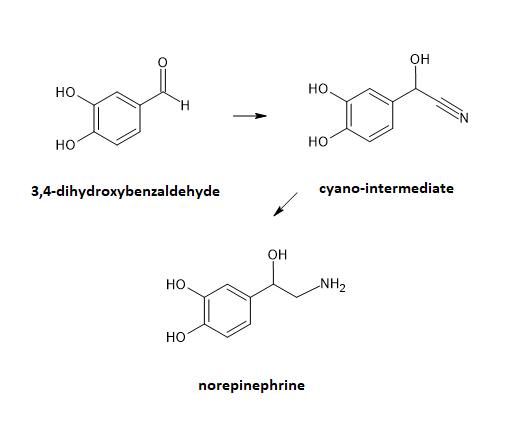
The starting material here is 3,4-dihydroxybenzaldehyde. This reaction comprises adding 3,4-dhb to hydrogen cyanide gas condensed into a reaction vessel and adding ethanolic acetate buffer then further mixing it with D-hydroxynitrile-lyase (enzyme) and solvent ethanol. This mixture affords the Cyanohydrin intermediate which is then reduced under catalytic hydrogenation to yield norepinephrine.
I’ve drawn a diagram to show this more clearly:
Albuterol:
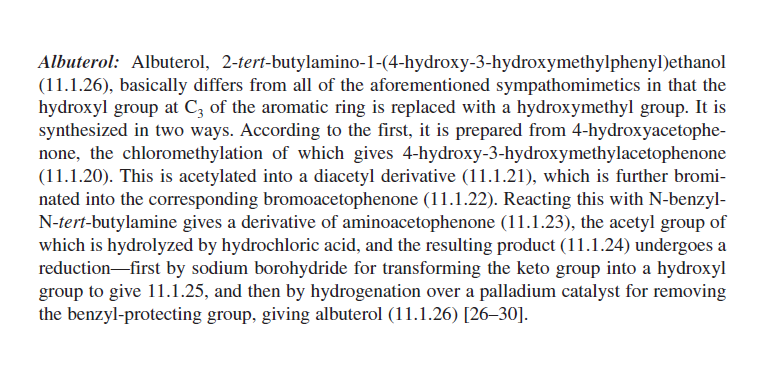
As an active analog of adrenaline, albuterol has many practical uses in pharmacology and is an agonist of the β2-adrenergic receptor.
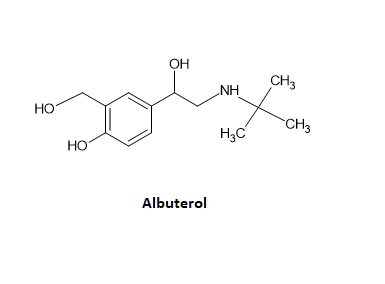
As it’s synthesis is thoroughly depicted, I will be showing the literature without going into further detail:
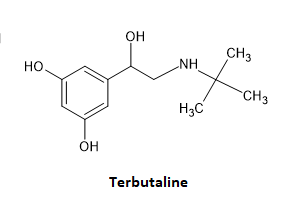
Terbutaline:
A strong sympathomimetic analog, this one bears many similarities in structure to Albuterol.
As it’s synthesis is thoroughly described, I will not be going into further detail:
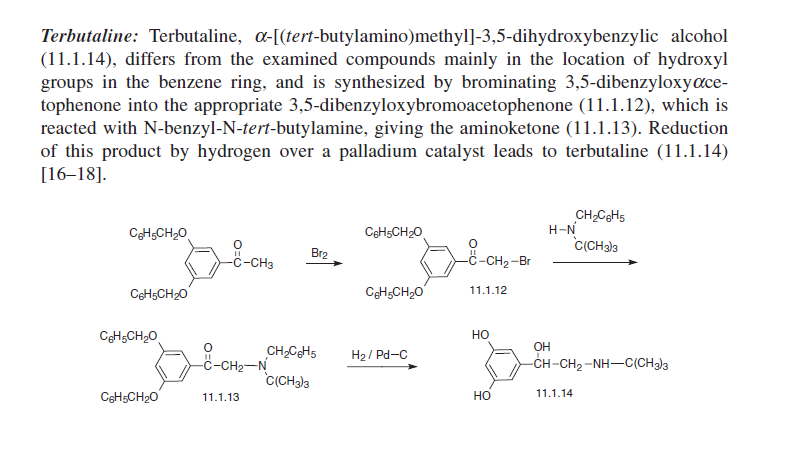
It should be known that there are many steps in this literature for both albuterol and terbutaline that involve physical uses of chemical materials and equipment lesser described or without description that may be too lengthy to describe here.
References:
R.F. Furchgott. The pharmacological differentiation of adrenergic receptors. Ann N Y Acad Sci. 1967 Feb 10;139(3):553-70.
George F. Koob. Corticotropin-releasing factor, norepinephrine, and stress. Vol. 46, Issue 9. (1999)
Investigation of epinephrine molecule and its synthesis. Theoretical and Natural Science 22(1):296-302
WO 2020/212157 A1
US Patent 3,720,582
R.S. Vardanyan, V.J. Hruby. 11-Adrenergic (Sympathomimetic) Drugs. Synthesis of Essential Drugs. 2006:143-159
Leave a Reply