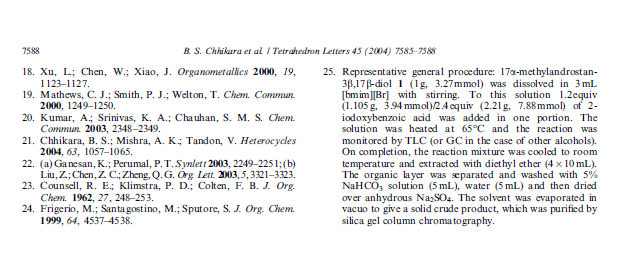
The starting material here is 17a-methyl-5a-androstane-3b,17b-diol (methyl-androstanediol) which is a powder then put into a liquid mixture of IBX (2-Iodoxybenzoic acid) in 1-butyl-3-methylimidazolium bromide. The overall mixture is then heated on a hot plate for approximately 2 hours or a little more depending on transformation confidence and/or TLC monitoring. The yielded Mestanolone/solvent/reagent mixture (as well as unchanged methylandrostanediol) is then cooled to room temperature and the Mestanolone is extracted with diethyl ether (which it is highly soluble in) using a separatory funnel. The diethyl ether is added into the funnel and the Mestanolone is expected to dissolve in it. The IBX/bromide material is left in the other dispersed liquid. The separatory funnel is then drained and the opposing solution (IBX/bmim(Br)) is discarded while the Mestanolone in solvent (dietether) or the organic layer is prepared for solvent extraction by vacuum. Any crude material (such as unaccounted for IBX/bmim contamination) in the organic layer is washed with Sodium Bicarbonate and water. It is then dried over Sodium Sulfate and a pasteur pipet is used to extract wanted from unwanted material. The diethyl ether is then finally removed as discussed before in vacuum to obtain crude Mestanolone which is then purified in this instance from other reaction products such as 1-en double bond introducted mestanolone, or M1t that may result from overheating or excessive time under heat during the chemical reaction.
Depending on the time that IBX is refluxed with methylandrostanediol a high yield of methyl testosterone can also be obtained as well as additional impurities resulting from double bond introduction.

Reference:
B.S. Chhikara et al. Tetrahedron Letters. 45 (2004) 7585 – 7588

Leave a Reply