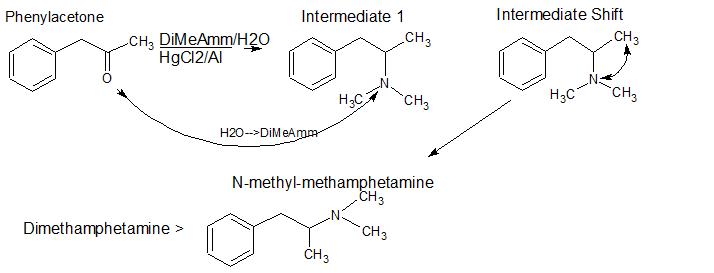
The chemical route chosen to obtain this one uses the same methods and materials as the route used to synthesize Amphetamine that I wrote about previously. It is a one-pot technique starting with phenylacetone. N-methyl-methamphetamine [or Dimethamphetamine] is far less written about in available literature and most certainly described in some lesser known patents and congressional research papers/presentations.
Exemplification towards N-Methyl-Methamphetamine:
Phenylacetone (g’s) dissolved in ethanol is added to a contained mixture of Mercuric Chloride (HgCl2), Aluminum-grit (Al-grit), and Dimethylammonium [otherwise known as Dimethylammonia]. With aggressive stirring under heated conditions the mixture is cooled to room temperature after reacting and any additional cooling should be applied on the basis described by Jansen et al. After which the necessary separation of conducing agents and any unreacted reagent itself (Dimethylammonium) is applied as well as eventual solvent extraction in vacuum to obtain the crude material Dimethamphetamine. Further molecular separation (unreacted phenylacetone and/or additional analagous impurities) and purification should be obtained through recrystallization.
Included in this synthesis and the same type of one for amphetamine is the fact that water (H2O) is used via reductive amination, or in this case, a reductive dimethylamination.
Reference:
J. Chem. Educ. 1974, 51, 10, 671
Leave a Reply