Atomic Introduction and Removal:
Compounds (made or biooccuring) are displayed and discovered in a wide variety of molecular formats and MWs entailing their chemical composition. It is of interest to me to commence discussing information related to a specific and broad subject of organic chemistry, that is heterocyclism and homocyclism. Atomic introduction, relative to org. chem., is the introduction of an atom or element into the structure of a molecule synthetically (or metabolically). When a C(Carbon) atom is introduced to a hydrocarbon ring structure or moiety it is known scientifically as a homocycle. When an O(Oxygen), N(Nitrogen), or other atom is introduced it is known as a heterocycle. Atomic removal is the replacing of an atom in a molecule to make heterocyclic or the removal of an atom to make ring-nor.
Steroidal Heterocycles:
The most basic steroidal heterocycle is one with simplicity and medical/pharmaceutical interests. Oxygenic molecular introduction, while indeed the most simple and sought after result, is of the most complicated synthetic procedures to perform correctly and inexpensively. There are multiple steps and intermediates involved in their production. A parental example is shown here; yielding an oxasteroid from cholic acid:
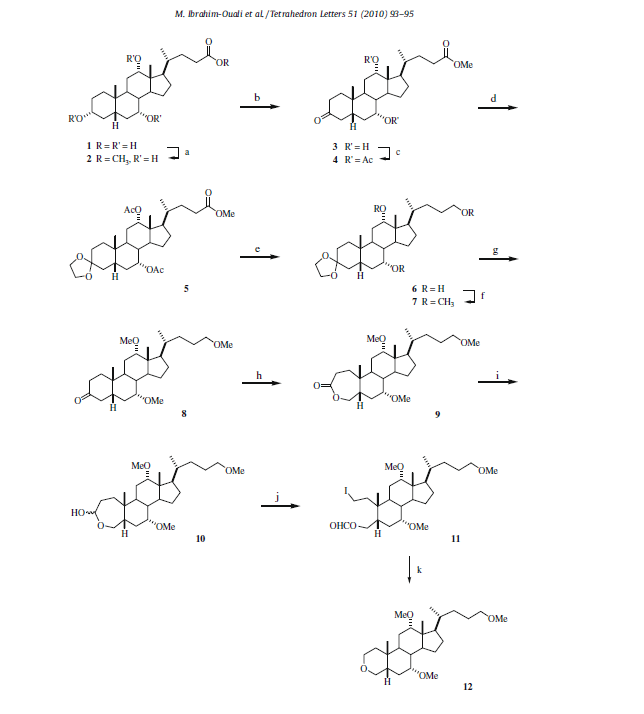
I have drawn a more technical diagram below:
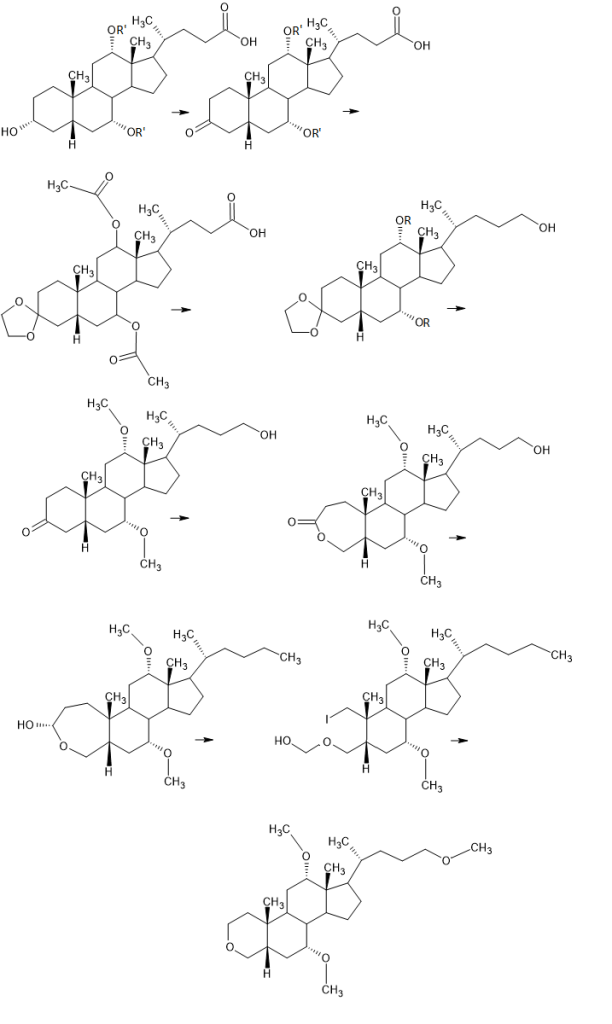
Step 1 & 2) Esterification leading to methyl cholate and regioselective oxidation. of the 3a-hydroxyl group of methyl cholate towards a 3-ketone utilizing silver carbonate.
Step 3) Diacetyl introduction and protective conversion of the 3-ketone to a 3-ketal.
Step 4) Reduction of the diacetate with Lithium Aluminum Hydride which also reduces the chained ketone coming off Ring D and cleaving it off.
Step 5) Deprotection of the 3-ketal functional moiety.
Step 6) Expansion and oxidointroduction of Ring A undergoing Baeyer – Villiger oxidation with chloroperbenzoic acid in solvent dichloromethane.
Step 7) Reduction of the oxa ring-A-homo-3-one ketone to a 3-hydroxyl leaving the ring A structure intact.
Step 8) The lactol structure is converted to an open seco-ring structure with mercury oxide-iodine in benzene solvent.
Step 9) The 3-oxa-5b-H-steroid is formed by the treatment of secosteroid with methyllithium in Tetrahydrofuran destabilizing the Iodic functional group, cleaving it, and closing the ring structure in ring A. Various byproducts or impurities are yielded and extracted out. GC-MS/HPLC is necessary for yield confidence.
Next up are a well known series of steroidal heterocycles termed scientifically as pyrazoles and isoxazoles. Unique from single atom substitution, these classes of compounds constitute Ring A conjoined cyclic attachments. The first known arousal of these compounds for re-search began in the late 1950s and early 60s.
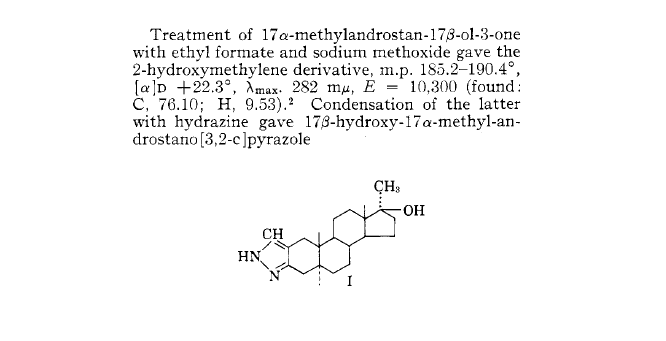
My illustration, drawn, is shown below:

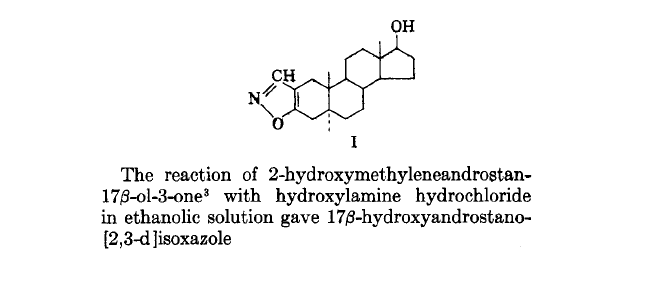
My illustration, drawn, is shown below:
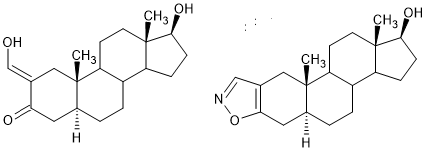
It is of notable interest that these two products are anabolic in nature, as well as androgenic which had been characterized in their re-search. They are vehicled for purposes of injection and when 17a-methylated can be taken orally. These types of steroids are wonderful examples of heterosteroids. As the syntheses are described I will elect to discuss the reagent catalyzed ring closure in both heterosteroids shown and depicted above. The shown hydroxymethylene intermediates are produced through basic reagent-solvent addition and reaction, however the ring closure is a bit more complex for basic description. Hydrazine for pyrazoles and hydroxylamine for isoxazoles destabilizing the reactive 3-ketone and 2′-hydroxyl to allow nucleophilic substitution on position 2- and 3- hydrogens (2′-OH and 3-reduced OH).
Steroidal Homocycles:
These opposing classes of homologated compounds with past notation require specific reagents for synthetic production. Opening of the ring under destabilization, intermediaile extraction, and ring closure are necessary steps for chemical conception. Typically with novel or unique uncharacterized biological activity, I have included an example from re-searchers in the journal of Steroids.

My illustration, drawn, is shown below:
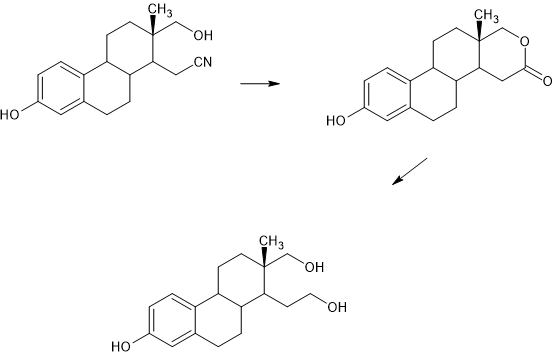
In this case and example, the starting steroid compound is of an open ring structure, derivized from pharmaceutical synthetic practice and likewise to most intermediates as starting function, purchased. The above intermediate 3-benzyloxy-17-hydroxy-16,17-secoestra-1,3,5(10)-trien-16-nitrile is treated with reagent:solvent adduction– p-toluene-sulfonic acid:benzene in solution to form the D-homoestratriene compound of interest [left to right]. The third compound and second step here involves re-opening the D-ring structure in affordance.
This D-homoestratriene is of minor pharmaceutical interest functioning biologically an antihormone, but is an important example of homologation and its synthetic procedure.
References:
Synthesis of Heterosteroids. First synthesis of oxa steroid from cholic acid. Malika I-Ouali. Nicaise B-Nkomendi, and L. Rocheblave. Tetrahedron Letters.(2009)
Steroidal [3,2-c] Pyrazoles. R. O. Clinton, A. J. Manson, F. W. Stonner, A. L. Beyler, G. O. Potts, and Aaron Arnold. J. Am. Chem. Soc. 81, 6, 1513–1514 (1959)
Communications. Steroidal [2,3-d]isoxazoles. R Clinton, A Manson, F Stonner, R Christiansen, A Beyler, G Potts, and Aaron Arnold. J. Org. Chem. 26, 1, 279 (1961)
Antihormonal potential of selected D-homo and D-seco estratriene derivatives. Suzana S Jovanović-Šanta, Edward T Petri, Olivera R Klisurić, Mihály Szécsi, Radmila Kovačević, and Julijana A Petrović. Steroids. 97, 45-53 (2015)
Leave a Reply